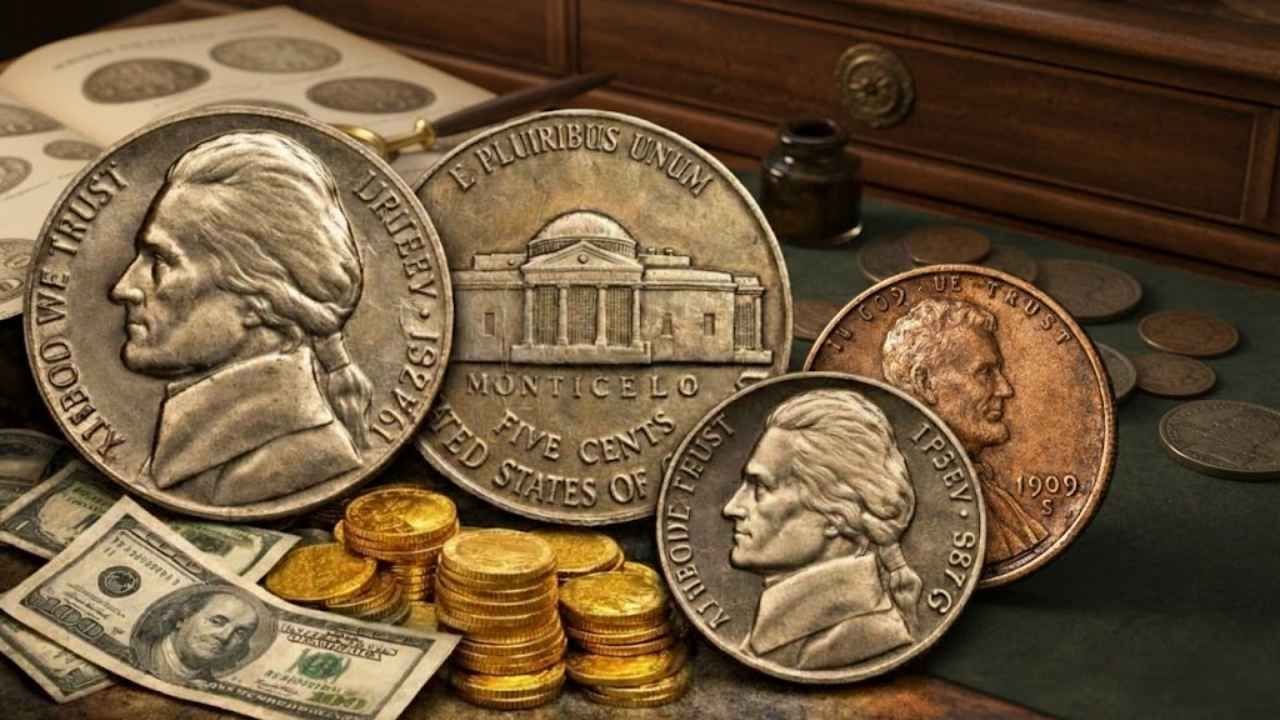
Jefferson Nickels have been a staple of American coinage since 1938, featuring Thomas Jefferson on the obverse and Monticello on the reverse. While millions have circulated over the decades, a select few stand out as rare treasures. These coins are more than pocket change—they are historical artifacts and, in many cases, valuable investments. In 2026, collectors continue to seek out the rarest Jefferson Nickels, with certain examples commanding prices that rival even gold coins.
1954-S Jefferson Nickel: The Crown Jewel
The 1954-S Jefferson Nickel is one of the most coveted in the series. Struck at the San Francisco Mint, it had a relatively low mintage, and most examples were weakly struck, making coins with full steps on Monticello exceptionally rare. Full-step coins indicate a sharp strike with all details intact, a feature that dramatically increases collector value. High-grade specimens can sell for over $35,000, cementing this coin as a crown jewel for Jefferson Nickel enthusiasts.
1942 Wartime Silver Nickel: Historical and Intrinsic Value
World War II created a shortage of nickel, prompting the U.S. Mint to issue wartime silver nickels containing 35% silver from 1942 to 1945. The 1942 issue is particularly notable, especially those featuring the large “P” mint mark above Monticello. Beyond their intrinsic silver content, these coins carry historical significance, reflecting America’s resourcefulness during wartime. In high grades, they can fetch over $1,000, appealing to both history buffs and collectors.
1939 Doubled Monticello Variety: A Striking Error
Error coins are always fascinating, and the 1939 Doubled Monticello is among the most famous Jefferson Nickel anomalies. This coin exhibits clear doubling on the reverse, especially on the words “Monticello” and “Five Cents,” resulting from a misstep in die preparation. Such doubled die varieties are scarce and highly desirable, with pristine examples selling for $5,000+. For error coin enthusiasts, this nickel represents the perfect intersection of rarity and intrigue.
1950-D Jefferson Nickel: The Key Date
The 1950-D Jefferson Nickel is legendary for its scarcity. With a mintage of only 2.6 million, it remains the lowest-production issue in the series. Initially overlooked, this coin has become a must-have for serious collectors. High-grade examples often sell for over $10,000, while even circulated specimens retain significant value. Its rarity makes the 1950-D a symbol of both historical and collector significance.
1971 No-S Proof Jefferson Nickel: Modern Rarity

Proof coins are specially struck for collectors, but errors occasionally occur, creating extreme rarity. The 1971 No-S Proof Jefferson Nickel lacks the expected “S” mint mark for San Francisco production. Only a handful are known to exist, making this coin one of the most valuable modern Jefferson Nickels. Auctions have seen prices exceed $20,000, reflecting its ultra-rare status and desirability among advanced collectors.
| Coin | Key Feature | Estimated Value (2026) | Collector Appeal |
|---|---|---|---|
| 1954-S Jefferson Nickel | Low mintage, full steps rarity | $35,000+ | High-grade scarcity |
| 1942 Wartime Silver Nickel | Silver composition, WWII history | $1,000+ | Historical and intrinsic value |
| 1939 Doubled Monticello | Famous doubled die error | $5,000+ | Error coin enthusiasts |
| 1950-D Jefferson Nickel | Lowest mintage in series | $10,000+ | Key date must-have |
| 1971 No-S Proof Nickel | Missing mint mark error | $20,000+ | Ultra-rare proof variety |
Historical Context
Each of these rare Jefferson Nickels tells a story about American history. Wartime silver nickels showcase national resourcefulness, doubled die varieties highlight early minting challenges, and low-mintage coins like the 1950-D emphasize how scarcity transforms ordinary circulation into prized collectibles. Together, they reflect the intersection of history, artistry, and numismatics.
Collecting Strategies in 2026
Entering the Jefferson Nickel market requires strategy. Collectors should focus on coins with strong eye appeal, certified grades, and historical or error significance. Error coins and low-mintage issues tend to appreciate steadily, while proof varieties with anomalies are particularly desirable. Building a collection around these rare nickels not only preserves history but can also offer significant investment potential.
The Role of Grading
Grading is crucial for determining value. Coins are assessed on a scale from Poor (P-1) to Mint State (MS-70), with even small differences affecting price dramatically. Certified coins provide assurance of authenticity and condition, essential for high-value pieces. Features such as full steps on Monticello or cameo proof finishes can elevate a coin’s worth significantly.
Auction Records and Market Trends
Auction results underscore the strong demand for rare Jefferson Nickels. The 1954-S with full steps has surpassed $35,000, while the 1971 No-S Proof has sold for more than $20,000. These record sales reflect limited supply and heightened collector interest. In 2026, the market remains robust, with rare Jefferson Nickels continuing to attract both new and seasoned collectors.
Final Verdict
While Jefferson Nickels are common in everyday circulation, hidden among them are treasures worth thousands. From wartime silver issues to minting errors and low-mintage rarities, these coins offer a rich narrative of American history and numismatic excellence. In 2026, the top five rare Jefferson Nickels remain highly sought-after, proving that even small change can hold extraordinary value and historical significance.